
Leaky Gut: When the Intestinal Barrier Stops Controlling What Gets Through.
Your gut lining is not passive plumbing. It is a living, selective barrier that decides what can cross from the digestive tract into your body — and what should stay out.
When that barrier becomes more permeable, larger food antigens, bacterial fragments, and microbial products can have greater access to the immune system beneath the lining. That can increase immune activation and inflammatory signaling.
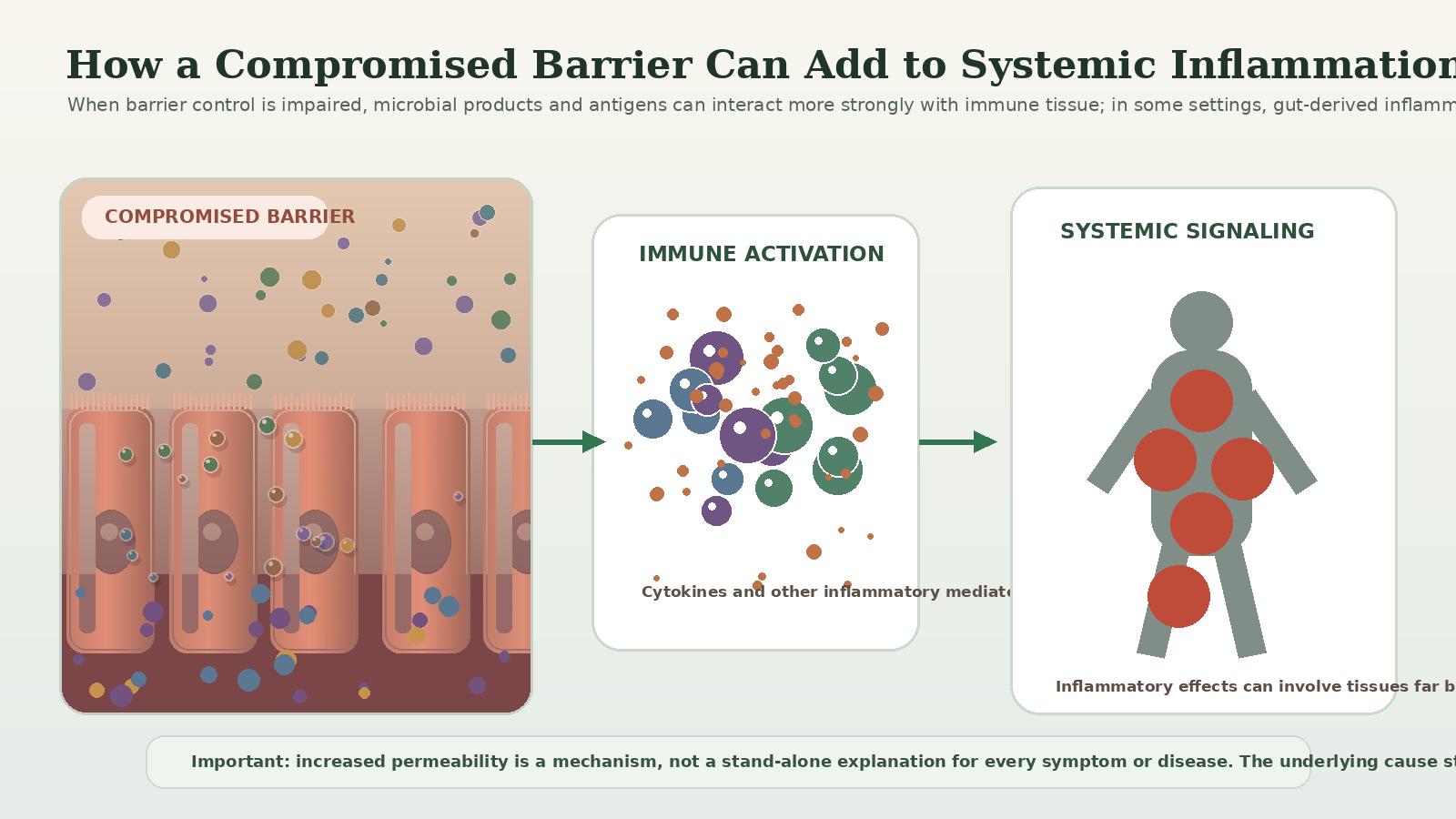
This matters because the effects do not always stay inside the gut. In some settings, gut-derived inflammatory signals and bacterial products can reach the circulation and contribute to systemic inflammation.

What Is Increased Intestinal Permeability?
Your intestinal lining is supposed to be permeable — just not indiscriminately permeable.
The intestinal wall is made of a single layer of specialized cells connected by structures called tight junctions. These junctions help control movement between the digestive tract and the tissue beneath it.
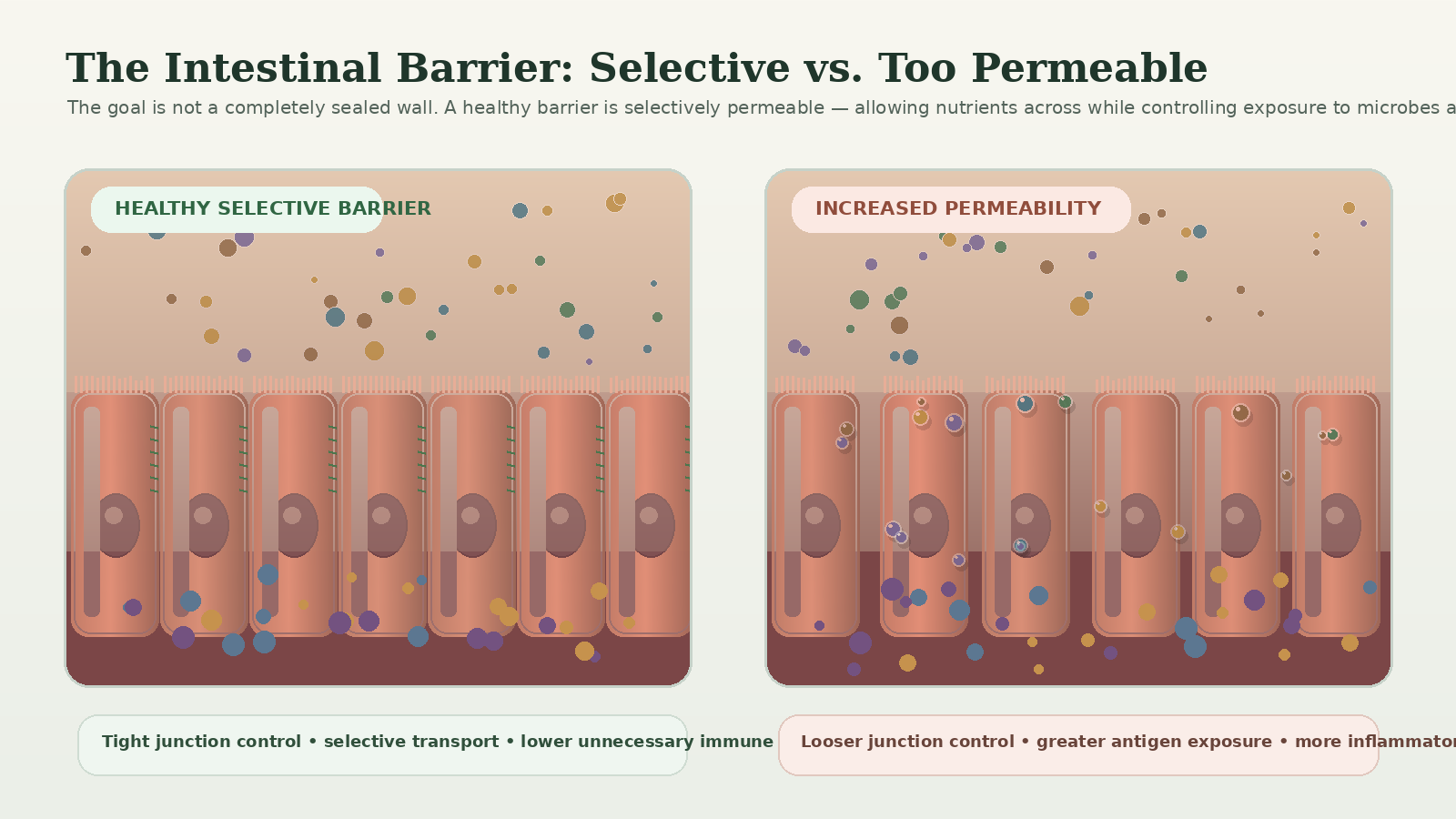
A healthy barrier allows digested nutrients, water, electrolytes, and other appropriate molecules to cross while limiting unnecessary exposure to bacteria, bacterial products, and larger antigens.
Increased intestinal permeability means that barrier control has become less effective. Material that would normally have limited access to the underlying immune system can cross more easily.
That does not mean the gut suddenly becomes full of giant holes. It means the highly regulated barrier has become too permissive.
This is a barrier-function problem, not an internet buzzword.
Your Intestinal Lining Is One of the Body’s Most Important Immune Borders.
The barrier is not just a row of cells. Several layers work together to decide what the immune system is exposed to.
A Healthy Barrier Controls Exposure. A More Permeable Barrier Loses Some of That Control.
That difference matters because greater exposure underneath the intestinal lining means the immune system has more material to respond to.
Increased Permeability Usually Has Context Behind It.
The important question is not simply, “Do I have leaky gut?” It is, “What is stressing the barrier, and is that stress still present?”
Celiac disease and inflammatory bowel disease are well-established examples of conditions in which intestinal barrier function can become abnormal.
Nonsteroidal anti-inflammatory drugs can injure gastrointestinal mucosa and can increase intestinal permeability in some settings.
Alcohol can impair barrier function, especially with heavier or repeated exposure.
Pathogens and the inflammation they trigger can disrupt epithelial cells, mucus, and tight-junction regulation.
Changes in gut microbes and their metabolites can influence mucus, epithelial cells, tight junctions, and local immune signaling.
Explore the Microbiome →Diet affects barrier health through nutrients, microbial fermentation, bile acids, and inflammatory signaling. The pattern matters more than one “bad” food.
The gut–brain axis can influence motility, immune activity, and barrier regulation. Chronic stress does not explain everything, but it can add strain.
Explore the Gut–Brain Connection →Inflammation can weaken barrier function — and a weakened barrier can increase immune exposure, creating a cycle worth interrupting.
Why Increased Permeability Can Matter Far Beyond Digestion
When the barrier becomes more permeable, the immune system beneath the gut lining can be exposed to more bacterial fragments, food antigens, and microbial products.
One important example is lipopolysaccharide — LPS, a component of certain bacterial cell walls. In some settings, bacterial products such as LPS can reach the circulation and stimulate inflammatory pathways outside the intestine.
That is the core reason gut-barrier dysfunction can contribute to systemic inflammation. It does not mean every case of systemic inflammation starts in the gut. It means a compromised gut barrier can become one meaningful source of inflammatory input.
There Is No Single “Leaky Gut Symptom.”
Barrier dysfunction can exist with digestive symptoms, body-wide symptoms, or sometimes very few obvious symptoms. That is why the pattern matters more than a checklist.
“Leaky Gut” Gets Oversold Online — but Dismissing the Barrier Is Just as Unhelpful.
The strongest position is in the middle: increased intestinal permeability is real physiology, but it is not a magic explanation for every symptom.
“Leaky gut is not real.”
Increased intestinal permeability is a well-documented physiologic phenomenon. The phrase “leaky gut syndrome” is where the internet often adds claims that go beyond the evidence.
“If my barrier is leaky, I must have obvious gut symptoms.”
Not necessarily. Barrier dysfunction is documented in several diseases and physiologic states, and symptom severity does not perfectly measure permeability.
“A commercial zonulin test proves I have leaky gut.”
Many commonly used commercial zonulin assays have major validity problems and may not measure zonulin itself. A single result should not be treated as definitive proof of permeability.
The Goal Is to Reduce the Stress on the Barrier — and Give the Intestine What It Needs to Maintain It.
There is no single “seal the gut” supplement. Barrier health is a systems problem, so support should focus on the environment, the underlying cause, and the basics the intestinal lining depends on.
Celiac disease, IBD, infection, and other digestive disorders need appropriate medical management rather than generic barrier supplements.
Fiber and resistant starch can support microbial production of short-chain fatty acids when they are tolerated.
Protein, vitamins, minerals, essential fats, and plant compounds provide building blocks used by intestinal and immune cells.
Heavy alcohol exposure and unnecessary NSAID use can work against barrier health. Medication decisions should be discussed with the appropriate clinician.
Persistent constipation or diarrhea changes the gut environment and deserves more than symptom suppression.
Explore Constipation & Diarrhea →Sleep and stress influence the gut–brain axis, eating patterns, immune function, and digestive physiology.
More variety can support nutrition and microbial diversity, but aggressive fiber loading can backfire when the gut is already irritated.
Some nutrients and microbial products are being studied for barrier support, but they should fit a reasoned plan rather than a giant “gut repair” stack.
Can Increased Intestinal Permeability Be Measured?
Yes, permeability can be studied using methods such as oral probe tests — often involving different-sized sugars — along with specialized tissue and research methods.
The challenge is that these methods are not routinely used in every clinical setting, and interpretation can depend on which part of the intestine is being studied and why the test was ordered.
A scientifically real phenomenon can still have imperfect everyday testing.
One Lab Number Should Not Run the Entire Diagnosis.
Zonulin became popular as a marker of gut permeability, but studies have shown that widely used commercial ELISA tests may detect proteins other than zonulin and correlate poorly with functional permeability testing.
Do Not Turn Serious GI Symptoms Into a Wellness Experiment.
Some symptoms deserve prompt conventional evaluation before any gut-barrier program is considered.
Years of Digestive Dysfunction Should Not Be Dismissed Just Because It Is Not an Emergency.
Barrier function is influenced by the environment inside the gut every day. If that environment is repeatedly inflammatory, poorly tolerated, or disrupted, simply accepting the symptoms as your normal does nothing to improve the conditions the intestinal lining is working under.
You do not need proof that the gut explains every symptom before you decide that digestion, microbiome health, bowel function, and barrier support deserve attention.
Let’s Find Out Whether Barrier Stress Is Part of the Bigger Pattern.
If you have long-standing digestive symptoms, food reactions, bowel changes, fatigue, skin concerns, or inflammatory issues, the Health Clarity Session is where we organize the story and decide whether the gut barrier deserves focused attention.
DocEllisDC is the education and wellness hub. Ellis Mobile Chiropractic is the active one-on-one care arm where Dr. Ellis works directly with patients.
Related Gut Health Topics
The intestinal barrier sits at the intersection of the microbiome, immune system, nutrient environment, and gut–brain signaling — which is why it connects with so many symptom patterns.
Leaky Gut / Intestinal Permeability FAQ
Is leaky gut a real medical phenomenon?
Yes. Increased intestinal permeability is a documented physiologic phenomenon involving changes in intestinal barrier function. The problem is that the phrase “leaky gut syndrome” is sometimes used online to make claims that go well beyond what permeability alone can prove.
Does increased permeability mean literal holes in my intestine?
No. The issue is usually altered regulation of the intestinal barrier, including the spaces between epithelial cells and other parts of the barrier system. “Leaky” is a simple nickname for a more complex physiologic change.
What can cross a more permeable barrier?
Depending on the condition and the degree of barrier dysfunction, larger food antigens, bacterial fragments, microbial products such as LPS, and other luminal material may have greater access to underlying tissue or the circulation.
Can leaky gut cause systemic inflammation?
A compromised barrier can contribute to systemic inflammatory signaling by increasing immune exposure and, in some conditions, allowing bacterial products to reach the circulation. It is one possible source of inflammatory input, not the only cause of systemic inflammation.
Does leaky gut cause autoimmune disease?
Autoimmune disease is complex and involves genetics, immune regulation, environmental triggers, and other factors. Barrier dysfunction and microbial translocation are active areas of autoimmune research and may contribute to disease development or activity in susceptible people, but it would be too strong to claim that leaky gut alone causes every autoimmune disease.
Can a zonulin blood or stool test diagnose leaky gut?
Commercial zonulin testing has important limitations. Several widely used ELISA assays have been shown not to measure zonulin specifically, so a single zonulin result should not be treated as definitive proof of intestinal permeability.
Can the intestinal barrier improve?
Yes. The intestinal lining is dynamic and continually renews itself. Improvement depends heavily on the cause — for example, controlling celiac disease, IBD, infection, medication-related injury, alcohol exposure, or other ongoing stressors can be much more important than taking a generic “gut repair” product.
What is the best first step if I think barrier dysfunction is part of my problem?
Start with the bigger pattern: symptoms, bowel habits, food tolerance, medications, alcohol, recent infections, inflammatory conditions, nutrition, sleep, stress, and red flags. Then decide whether medical evaluation, foundational gut support, or targeted testing is the right next step.
Your Gut Barrier Is One of the Places Where Digestion Becomes Immune Biology.
When that barrier is healthy, it controls exposure. When it is repeatedly stressed, more immune stimulation can occur and inflammatory signals can extend beyond the intestine. That makes barrier health worth taking seriously — without turning it into an explanation for everything.
Learn About the Health Clarity SessionMedical references used to guide this educational page
- Intestinal Barrier Impairment, Preservation, and Repair: An Update. PMC11509958.
- Gut microbiota, intestinal permeability, and systemic inflammation: a narrative review. PMC10954893.
- The Role of Intestinal Permeability in Gastrointestinal Disorders and Current Methods of Evaluation. PMC8427160.
- Gut Microbiota, Leaky Gut, and Autoimmune Diseases. PMC9271567.
- Blurring the picture in leaky gut research: how shortcomings of zonulin as a biomarker mislead the field of intestinal permeability. PMC8355880.
Educational use only. This page does not diagnose increased intestinal permeability, infection, celiac disease, inflammatory bowel disease, autoimmune disease, or systemic inflammation. Barrier dysfunction can be part of many different health conditions, and symptoms alone do not establish the cause. Seek appropriate medical evaluation for persistent, severe, or concerning symptoms.