
Constipation or Diarrhea? Your Gut Is Trying to Tell You Something.
Whether you are backed up, running to the bathroom, or swinging between the two, your bowel habits are one of the clearest windows into how your digestive system is functioning.
The goal is not to chase a perfect number of bowel movements. It is to understand your pattern — how often you go, what the stool looks like, whether you strain, whether there is urgency, whether you feel fully emptied, and what else is happening at the same time.
“Regular” Means More Than Going Every Day.
Some healthy people have bowel movements more than once a day. Others go less often. What matters is whether your bowel pattern is comfortable, predictable for you, and free from warning signs.
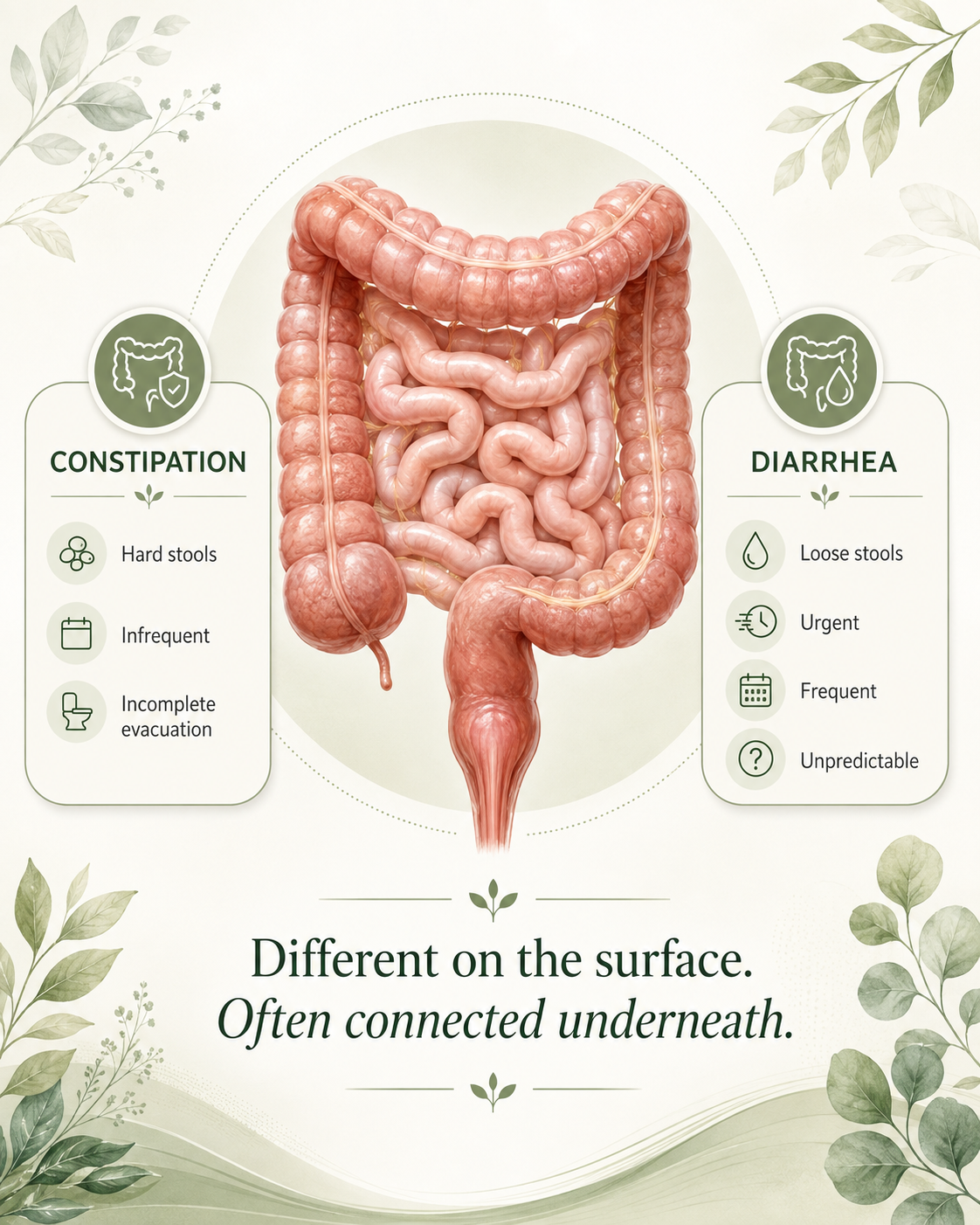
Different on the Surface. Sometimes Connected Underneath.
- Hard, dry, or lumpy stool
- Straining or discomfort
- Long gaps between bowel movements
- Feeling incompletely emptied
- Bloating or heaviness
- Loose or watery stool
- Urgent trips to the bathroom
- Frequent bowel movements
- Cramping or nausea
- Dehydration or fatigue when severe
Common Contributors to Bowel Irregularity
Constipation and diarrhea can have very different causes — and sometimes overlapping ones. More than one factor may be involved at the same time.
Motility
The muscles and nerves of the digestive tract help move food and waste forward. Movement that is too slow can contribute to constipation. Movement that is too fast can contribute to loose stools.
Food, Fiber & Fluids
Too little fiber, sudden large increases in fiber, poor hydration, sugar alcohols, certain carbohydrates, or major diet changes can all affect stool form and frequency.
Microbiome
The microorganisms in the gut help process food and interact with the intestinal environment. Changes in that ecosystem can sometimes accompany changes in gas, stool consistency, and bowel patterns.
Learn about the microbiome →Medications & Supplements
Iron, opioid pain medicines, some antacids, magnesium-containing products, antibiotics, and many other medications or supplements can change bowel habits.
Food Intolerances
Lactose, fructose, sugar alcohols, and other poorly absorbed carbohydrates can trigger loose stool or gas in some people. Restricting food without a plan can create new problems.
Explore food sensitivities →Gut-Brain Signaling
The bowel is heavily controlled by the nervous system. Stress does not mean symptoms are “all in your head,” but brain-gut signaling can affect speed, sensitivity, urgency, and pain.
Explore the gut-brain connection →Inflammation or Disease
Conditions such as celiac disease, inflammatory bowel disease, thyroid problems, diabetes, or other medical issues can change bowel function and deserve appropriate evaluation.
Explore gut health & immune activity →Infection or Parasites
Viruses, bacteria, and parasites can cause diarrhea. Some infections can also leave temporary digestive changes behind after the infection itself has passed.
What You Track Can Be More Useful Than What You Guess.
A bowel movement is not just “good” or “bad.” Details can help show whether the issue is primarily frequency, stool form, motility, urgency, incomplete emptying, food response, or something else.
If symptoms are ongoing, even a simple one- or two-week record can be useful when you talk with a healthcare professional.
Constipation and Diarrhea Are Not Simple Opposites.
One means stool is moving or passing too slowly or with difficulty. The other means stool is loose and often moving too quickly. But the same person can experience both at different times.
Manage the Bathroom Problem.
- Add fiber without knowing whether more fiber is actually helpful
- Use laxatives or stool softeners repeatedly
- Take anti-diarrheal medicine every time stool becomes loose
- Try random probiotics
- Cut out more and more foods
- Use a cleanse or “detox” to reset the gut
Why Is the Bowel Behaving This Way?
- Is stool moving too slowly, too quickly, or both at different times?
- Are medications or supplements contributing?
- Are there food triggers or poor carbohydrate absorption?
- Is constipation causing incomplete evacuation or overflow?
- Did symptoms begin after an infection, travel, antibiotics, or illness?
- Are there warning signs that require medical testing rather than wellness care?
Loose Stool Has an Infection Side to the Story.
Acute diarrhea is commonly caused by viral gastroenteritis, food poisoning, or medicine side effects. Foodborne illness can be caused by viruses, bacteria, or parasites.
Infections and Parasites Matter. Context Matters More.
If loose stool starts suddenly after travel, questionable food or water, exposure to illness, or another clear risk, infection deserves serious consideration.
Some infections clear quickly. Others can last longer, and some people continue to have digestive problems after the original infection is gone. Stool testing may be appropriate when the history and symptoms support it.
That is very different from assuming that every case of constipation, diarrhea, bloating, or fatigue is caused by a parasite.
Good gut-health reasoning keeps parasites on the list when they belong there — not at the top of every list automatically.
Your Bowel Habits Should Not Quietly Take Over Your Life.
A short-lived change after travel, an unusual meal, illness, or a routine change can happen. Repeated or worsening bowel changes deserve more attention.
Some bowel changes need medical attention sooner.
Do not treat the following as routine “gut-health” symptoms first:
- Blood in the stool or black, tarry stool
- Severe or constant abdominal or rectal pain
- Persistent vomiting
- High fever with diarrhea
- Signs of dehydration such as very dark urine, dizziness, extreme thirst, or urinating much less
- Unexplained weight loss
- Constipation with inability to pass gas
- Six or more loose stools in a day, or diarrhea lasting more than two days in an adult
Pregnancy, older age, recent antibiotics, or a weakened immune system can lower the threshold for seeking medical advice.
We Look Beyond the Bathroom.
Constipation and diarrhea are symptoms, not programs.
The goal is to understand enough of the picture to know what can reasonably be addressed through nutrition, lifestyle, gut-health support, and coaching — and when medical evaluation should come first.

Let’s Figure Out What Your Bowel Pattern Means for You.
The Health Clarity Session is where general information becomes a conversation about your symptoms, history, goals, and best next step.
DocEllisDC is the education and wellness hub. Ellis Mobile Chiropractic is the active one-on-one care arm where Dr. Ellis works directly with patients. The handoff is intentional.
Related Gut Health Topics
Bowel changes often overlap with other digestive concerns. These pages help connect the pieces.
Constipation & Diarrhea FAQ
How often should I have a bowel movement?
There is no single schedule that is normal for everyone. Constipation can include fewer than three bowel movements a week, but hard stools, straining, painful passage, and incomplete emptying also matter. Your normal pattern and how you feel are important.
Can I be constipated if I go every day?
Yes. Daily bowel movements do not rule out constipation if stools are hard, difficult to pass, require straining, or leave you feeling incompletely emptied.
Why do I alternate between constipation and diarrhea?
Alternating patterns can occur for many reasons, including disorders of gut-brain interaction such as IBS, changes in motility, medications, food reactions, and other digestive conditions. The pattern itself does not identify the cause.
Can constipation actually cause loose stool?
Sometimes. Severe constipation can allow watery stool to leak around hard stool that is difficult to pass. That is one reason a history of constipation can still matter even when a person is having episodes of loose stool.
Should I just add more fiber?
Fiber can help many people with constipation, and current gastroenterology guidelines support fiber supplementation for chronic idiopathic constipation. But more is not always better. Sudden increases can worsen gas and bloating, and the right approach depends on the pattern.
Should I take a probiotic?
Not automatically. Different probiotic strains have different effects, and “probiotic” is not one treatment. It makes more sense to first understand the bowel pattern and what else may be contributing.
Could diarrhea be a parasite?
Yes, parasites can cause diarrhea, especially with certain travel, food, water, or exposure histories. Bacteria and viruses are also common causes. Testing is most useful when the history and symptoms give a reason to look for infection.
Do I need a Gut Health Program just because my bowel habits are irregular?
No. Irregular bowel habits alone do not tell us what program, if any, is appropriate. The Health Clarity Session is designed to help determine the most sensible next step.
You Don’t Have to Plan Your Life Around the Bathroom.
If constipation, diarrhea, or both keep coming back, let’s look at the pattern and decide what deserves attention next.
Learn About the Health Clarity SessionMedical references used to guide this educational page
- National Institute of Diabetes and Digestive and Kidney Diseases. Definition & Facts for Constipation.
- National Institute of Diabetes and Digestive and Kidney Diseases. Symptoms & Causes of Constipation.
- National Institute of Diabetes and Digestive and Kidney Diseases. Symptoms & Causes of Diarrhea.
- National Institute of Diabetes and Digestive and Kidney Diseases. Diagnosis of Diarrhea.
- American Gastroenterological Association / American College of Gastroenterology. Pharmacological Management of Chronic Idiopathic Constipation. 2023.
Educational use only. This page does not diagnose the cause of constipation, diarrhea, or another bowel change and is not a substitute for medical care. Blood in the stool, black or tarry stool, severe or constant abdominal or rectal pain, persistent vomiting, high fever, significant dehydration, unexplained weight loss, inability to pass gas with constipation, or other concerning symptoms should be evaluated promptly by an appropriate medical professional.