
Food Keeps Seeming to Set You Off? Let’s Figure Out What Kind of Reaction You’re Actually Having.
Bloating after dairy. Diarrhea after certain meals. A stomach ache that keeps showing up around the same foods. Maybe you have started wondering whether you are “sensitive” to half the grocery store.
The first step is not cutting out more food. It is getting clearer about the pattern — because food allergy, food intolerance, celiac disease, IBS-related food triggers, and the broad label “food sensitivity” are not the same thing.
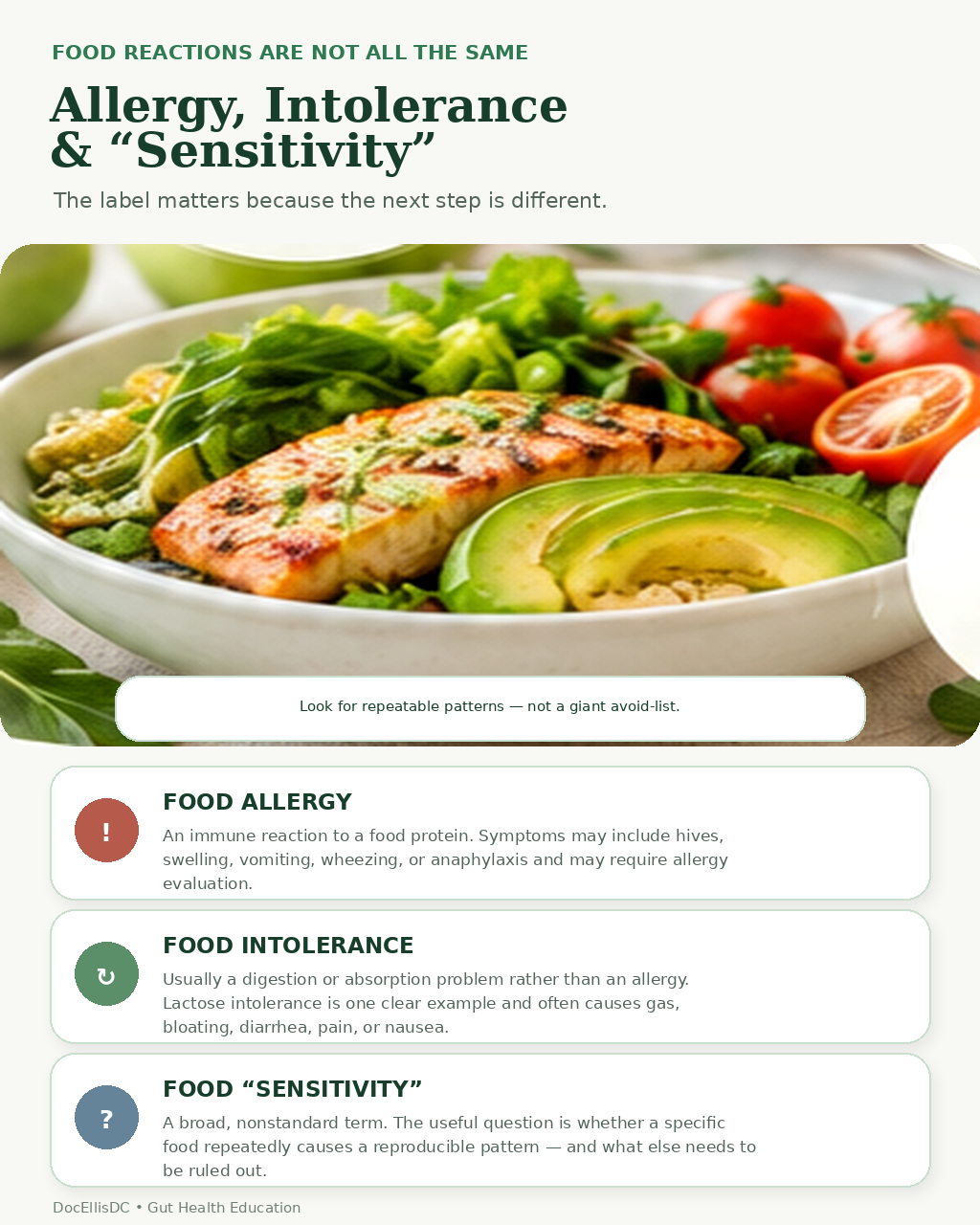
Food Allergy, Food Intolerance and “Food Sensitivity” Are Not Interchangeable.
They may all get blamed on food, but the biology — and the risk — can be very different.
An immune reaction that can become serious
A true food allergy involves the immune system. Reactions may include hives, swelling, vomiting, wheezing, throat symptoms, or anaphylaxis. Suspected allergy belongs with appropriate allergy evaluation — not a home food challenge.
A problem digesting or processing a food
Food intolerance usually affects the digestive system rather than causing anaphylaxis. Lactose intolerance is a classic example: low lactase activity allows lactose to reach the colon, where it can produce gas, fluid, bloating, diarrhea, pain, or nausea.
A common phrase, not one single standardized diagnosis
People use this term for delayed, inconsistent, or hard-to-explain symptoms they associate with food. The useful question is not whether the label sounds right; it is whether a specific exposure repeatedly produces a convincing pattern and what else could explain it.
What Food Intolerance Often Looks Like
Food intolerance is most convincing when the same type or amount of food repeatedly produces a similar digestive response.
Not Every Symptom After a Meal Proves the Food Caused It.
Fatigue, headache, brain fog, skin symptoms, joint discomfort, and mood changes are real symptoms — but they have many possible causes.
If those symptoms seem tied to food, the pattern needs to be strong enough to survive a few questions:
There Is More Than One Mechanism.
That is why a single giant list of “bad foods” rarely tells the whole story.
Lactose Malabsorption
Low lactase activity means lactose is not fully digested in the small intestine. Symptoms depend partly on how much lactose is consumed and how much an individual can tolerate.
If bloating is part of your pattern, explore Bloating →Fermentable Carbohydrates
Certain poorly absorbed or highly fermentable carbohydrates can increase gas, fluid, and digestive symptoms in susceptible people, including some people with IBS.
Explore Bloating →Gluten-Related Conditions
Celiac disease, wheat allergy, and non-celiac gluten/wheat sensitivity are different entities. Long-term gluten restriction before proper testing can make celiac evaluation harder.
Learn more about autoimmune-related gut concerns →True Food Allergy
An immune reaction to specific food proteins can cause immediate or rapid symptoms and, in some people, anaphylaxis. This is a different risk category from intolerance.
If reactions include hives or skin symptoms, explore Skin Rashes & Eczema →IBS & Gut–Brain Interaction
Some people with IBS notice clear food triggers even when there is no allergy. The bowel, microbiome, motility, sensation, and brain–gut signaling can all influence symptoms.
Explore the Gut–Brain Connection →Inflammatory or Digestive Disease
Celiac disease, inflammatory bowel disease, infections, and other digestive conditions can sometimes create symptoms that look like “food intolerance.”
Explore autoimmune-related gut concerns →Medications & Supplements
Medicines, magnesium, sugar alcohols, fiber products, and other supplements can change bowel habits or create symptoms that get blamed on food.
Microbiome & Barrier Research
The microbiome and intestinal barrier interact with digestion and immune function. They are legitimate research areas, but a symptom after eating does not by itself prove “dysbiosis” or “leaky gut.”
Be Careful With Broad IgG “Food Sensitivity” Panels.
It is tempting to want one blood test that prints out every food you should avoid. Unfortunately, professional allergy organizations do not recommend food-specific IgG testing for diagnosing food allergy, intolerance, or “sensitivity.”
- IgG to foods can simply reflect normal exposure.
- A long list of positives can lead to unnecessary restriction.
- Removing dozens of foods can make eating harder without identifying the real cause.
- True allergy testing should be targeted to the history — not ordered as an indiscriminate panel.
What Kind of Evidence Would Actually Change the Plan?
Different problems require different tools.
- A detailed history may be enough to recognize a strong intolerance pattern.
- Breath testing can be useful in selected cases such as lactose malabsorption.
- Suspected food allergy may involve focused skin testing, specific-IgE blood testing, and sometimes a medically supervised oral food challenge.
- Celiac disease has its own testing pathway and should be evaluated while the person is still consuming gluten unless a clinician directs otherwise.
- Some cases are best approached with a structured, temporary elimination followed by planned reintroduction.
Identify. Test the Pattern. Reintroduce. Protect Nutrition.
The endpoint should not be the smallest diet you can tolerate. It should be the broadest diet that works for your body.
Food-Related Symptoms Sometimes Need More Than a Diet Experiment.
A healthcare professional should be involved when the pattern is severe, persistent, or suggesting something beyond a simple intolerance.
Food allergy warning signs need a different level of urgency.
Seek emergency care for signs of a severe allergic reaction, especially after eating:
- Trouble breathing, wheezing, or throat tightness
- Swelling of the lips, tongue, mouth, or throat
- Fainting, severe dizziness, or signs of shock
- Rapidly developing hives or swelling together with breathing, throat, or circulation symptoms
- Repeated vomiting with other signs of an allergic reaction
Those symptoms are not a “food sensitivity” problem to sort out later. They require appropriate emergency care.
We Are Not Looking for More Foods to Fear.
We are looking for enough clarity to know which foods matter, which foods do not, and what other health patterns may be hiding underneath the assumption that “everything bothers my stomach.”

Let’s Figure Out Which Food Reactions Are Real, Repeatable and Worth Acting On.
The Health Clarity Session is the bridge between “I think food is bothering me” and a more organized next step.
DocEllisDC is the education and wellness hub. Ellis Mobile Chiropractic is the active one-on-one care arm where Dr. Ellis works directly with patients.
Related Gut Health Topics
Food-related symptoms often overlap with other digestive patterns. These pages help connect the pieces.
Food Sensitivities & Intolerances FAQ
What is the difference between food allergy and food intolerance?
Food allergy involves the immune system and can potentially cause anaphylaxis. Food intolerance usually involves digestion or absorption and causes uncomfortable symptoms such as gas, bloating, pain, diarrhea, or nausea without the same anaphylaxis risk.
Is “food sensitivity” a real diagnosis?
The phrase is widely used, but it does not refer to one single standardized medical diagnosis. It is best treated as a description of a suspected food-related pattern that still needs to be defined more carefully.
Are IgG food sensitivity panels accurate?
Professional allergy organizations recommend against using food-specific IgG testing to diagnose food allergy, intolerance, or “sensitivity.” IgG can reflect normal exposure to food and broad panels can lead to unnecessary restriction.
How do I know whether dairy is actually bothering me?
A consistent relationship between lactose-containing foods and symptoms is useful information. In selected cases, clinicians may use a lactose hydrogen breath test. Many people with lactose intolerance can tolerate some lactose rather than needing complete dairy avoidance.
Should I stop eating gluten to see if I feel better?
If celiac disease is a possibility, it is usually better to discuss testing before starting a strict gluten-free diet because avoiding gluten can affect test results. Wheat allergy and non-celiac gluten/wheat sensitivity are different issues and need different reasoning.
Can food sensitivities cause brain fog or fatigue?
People sometimes report these symptoms around foods, but they are nonspecific and have many possible causes. A repeatable food relationship should be demonstrated rather than assumed from one episode or a broad laboratory panel.
Do I need to eliminate all foods that cause symptoms?
No. Some intolerances are dose-dependent, and the amount matters. The goal is generally to identify the smallest necessary restriction and maintain the broadest nutritionally adequate diet possible.
Can gut health make me react to more foods?
Digestive diseases, bowel sensitivity, motility, microbiome changes, and intestinal inflammation can influence how meals feel. But reacting to foods does not by itself prove dysbiosis or increased intestinal permeability. The surrounding clinical pattern matters.
You Should Not Have to Be Afraid of Your Next Meal.
If your diet keeps getting smaller while the answers are not getting clearer, let’s organize the pattern and decide what actually deserves attention.
Learn About the Health Clarity SessionMedical references used to guide this educational page
- American Academy of Allergy, Asthma & Immunology. Food Allergy.
- American Academy of Allergy, Asthma & Immunology. Food Intolerance Versus Food Allergy.
- American Academy of Allergy, Asthma & Immunology. The Myth of IgG Food Panel Testing.
- National Institute of Diabetes and Digestive and Kidney Diseases. Symptoms & Causes of Lactose Intolerance.
- NIAID-sponsored Expert Panel. Guidelines for the Diagnosis and Management of Food Allergy in the United States.
Educational use only. This page does not diagnose food allergy, food intolerance, celiac disease, IBS, “food sensitivity,” dysbiosis, or intestinal permeability. Food allergy can be life-threatening. Trouble breathing, throat swelling, fainting, severe dizziness, or other signs of anaphylaxis after food exposure require emergency medical care.