
Your Gut Health Affects More Than Your Digestion.
Your digestive system helps break down food, absorb nutrients, manage waste, support the intestinal barrier, communicate with your immune system, and stay connected with your brain.
When that system is struggling, your body may send signals that are easy to dismiss—or easy to treat one at a time without ever asking why they keep coming back.
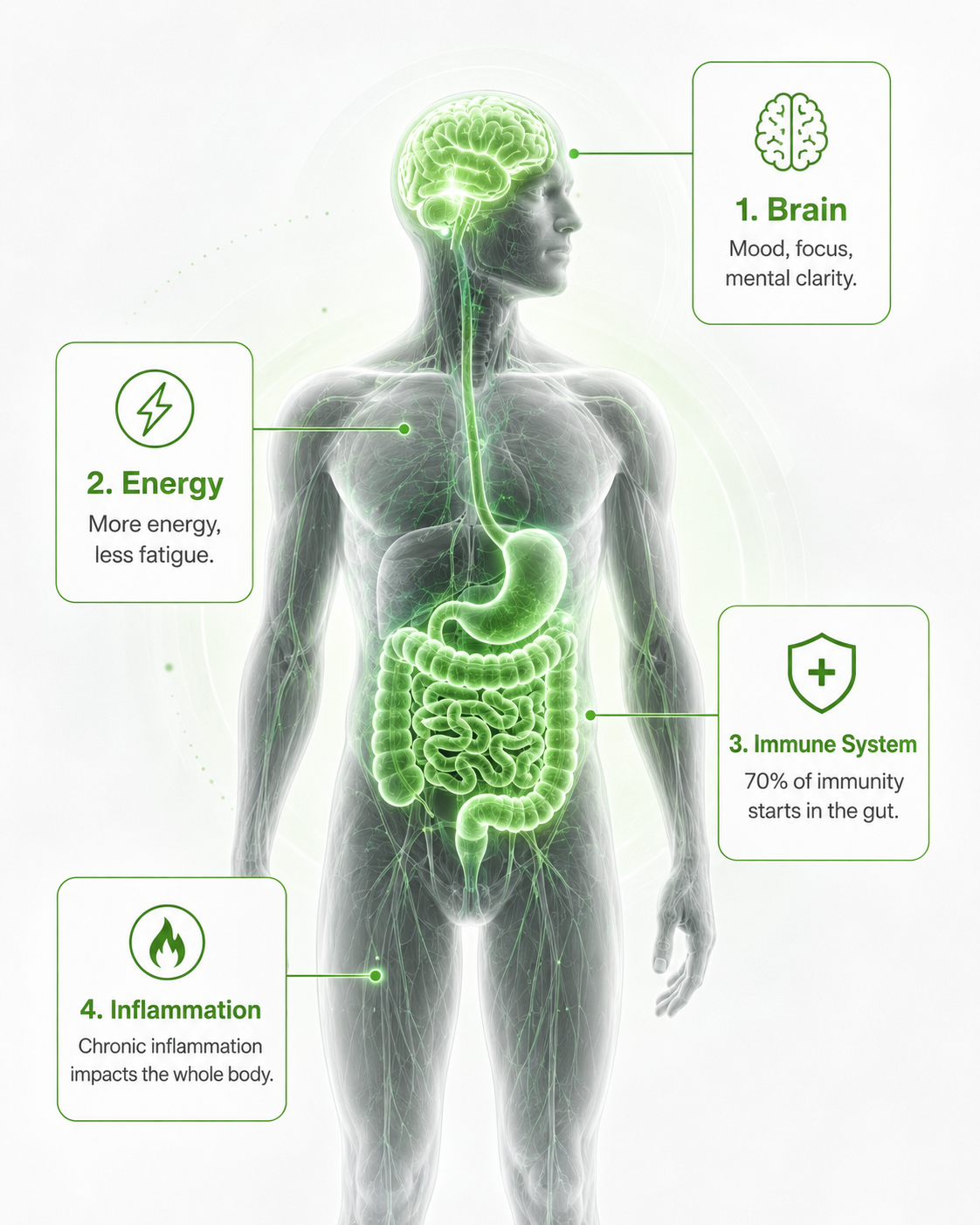
What Do We Mean by “Gut Health”?
Your digestive tract has several jobs happening at the same time.
It has to break food down. It has to absorb nutrients. It has to move waste out. It has to maintain a healthy environment for the trillions of microorganisms living inside it.
At the same time, the intestinal lining has to act like a smart security system—letting water and digested nutrients through while helping control contact with bacteria, toxins, food antigens and other material inside the gut.
That is why a gut-health problem may look like a bowel problem—but it can also show up as a much bigger pattern that deserves a closer look.
What Best Describes You?
You do not need to know the science before you begin. Start with the symptoms or questions that brought you here.
Constipation and/or Diarrhea / Loose Stool
Changes in frequency, consistency or ease can give useful clues about digestion, movement and the gut environment.
Start with digestion →Abdominal Pain or Bloating
Feeling swollen, tight, gassy or uncomfortable after eating should not automatically become “just normal for me.”
Explore the digestive system →Chronic or Frequent Fatigue / Tiredness
Fatigue has many causes, but digestion, nutrition and absorption can sometimes be part of the larger picture.
Explore nutrient absorption →Eczema, Skin Rashes or Hives
Skin and gut are separate organs, but immune activity, allergies and inflammation can overlap in important ways.
Explore immune activity →Nausea
Frequent or recurring nausea—especially without an obvious explanation—deserves attention rather than endless guessing.
Explore digestion →Food Sensitivities or Intolerances
If your “foods I cannot eat” list keeps growing, avoiding more foods may not answer the bigger question.
Explore the intestinal barrier →Autoimmune-Related Concerns
The gut barrier, microbiome and immune system are closely connected areas of ongoing medical research.
Explore inflammation & immunity →I Just Want to Know More
You do not need to be sick to care about gut health. Start with the foundations and learn how the system fits together.
Start with the basics →Your Gut Is More Than a Tube.
Food goes in. Waste comes out. But what happens between those two points is a busy, living system.
Your digestive tract contains human cells, mucus, digestive enzymes, nerves, immune cells and a huge community of microorganisms. They are constantly interacting.
That means a problem in one part of the system can change what happens in another. This is why focusing on only one symptom—or one supplement—may not tell you what the whole system needs.
Understand Gut Health
You do not need a medical degree. But understanding these six pieces makes the rest of the conversation much easier to follow.
1. The Microbiome
Your gut is home to trillions of microorganisms. They help process food components, make useful compounds, interact with the immune system and shape the environment inside the digestive tract.
When the normal community becomes disturbed, you may hear the word dysbiosis.
Medical term: dysbiosis2. Digestion
Healthy food still has to be broken down before your body can use it. Chewing, stomach acid, bile, pancreatic enzymes and movement through the gut all play a role.
Good nutrition is not only about what goes into your mouth. It is also about what your digestive system can do with it.
Break down → absorb → use3. The Gut Lining
Your intestinal lining is a selective barrier. It helps let water and digested nutrients through while controlling contact with food antigens, bacteria, bacterial material, toxins and other material inside the gut.
When this barrier becomes too permeable, the medical term is increased intestinal permeability—often called “leaky gut.”
Medical term: intestinal permeability4. Inflammation & Immunity
Inflammation is part of normal defense. The concern is when immune and inflammatory signals stay active when they should not.
The gut sits at a major meeting point between food, microbes, the intestinal barrier and immune tissue.
Defense is good. Constant alarm is not.5. The Gut-Brain Connection
Your brain and digestive system communicate in both directions through nerves, hormones, immune signals and microbial products.
Scientists call this the gut-brain axis. It helps explain why stress can affect the gut—and why gut signals can affect the brain.
Medical term: gut-brain axis6. Nutrient Absorption
You can eat excellent food and buy excellent supplements, but your body still has to absorb what you give it.
Most nutrient absorption happens in the small intestine after food has been broken into forms the body can use.
What you eat is only part of the story.What Does “Leaky Gut” Actually Mean?
Think of your intestinal lining like a very selective screen. The cells sit tightly next to each other, and structures called tight junctions help control what can pass between them.
If the barrier is damaged or those connections stop working normally, larger food antigens, bacterial products and other material inside the gut can have greater access to the tissues and immune system underneath.
That is increased intestinal permeability. “Leaky gut” is the common nickname—not a claim that your intestine has literal holes in it.
What Can Throw Gut Health Off?
Usually there is not one cartoon villain. Gut function can be influenced by several things that add up over time.
Food & Diet Patterns
Fiber, highly processed foods, food allergies or intolerances, hydration and the overall diet can change the digestive environment.
Stress & Sleep
Your nervous system helps control gut movement and secretion. Stress and poor sleep can change how the digestive system behaves.
Medications
Some medicines can affect stomach acid, bowel movement, the microbiome or other parts of digestive function. Never stop a prescribed drug without the prescribing clinician.
Infections & Parasites
Some infections and parasites can irritate the digestive tract, change bowel habits or disrupt the gut environment. Persistent symptoms may require appropriate medical testing.
Digestive Function
Problems with motility, stomach acid, bile, enzymes or other steps in digestion can change what reaches the rest of the intestinal tract.
Alcohol & Irritants
Alcohol and other irritants can affect the intestinal lining and digestive symptoms in some people, especially when exposure is frequent.
One of the biggest problems is that we can get used to feeling bad.
A Cleanse Is Not the Same Thing as Rebuilding Gut Health.
A probiotic, fiber supplement, elimination diet, digestive enzyme or cleanse may have a useful role for the right person. But no single tactic can tell you what the entire system needs.
One-Tactic Thinking
“I have a gut symptom, so I will try one gut product.”
- May help one symptom
- May be useful for a specific need
- Easy to start
- Does not automatically explain why symptoms keep returning
Systems Thinking
“Let’s look at the pattern and decide what deserves attention first.”
- Looks at digestion, bowel patterns and food reactions together
- Considers microbiome and barrier health
- Builds an ordered strategy instead of random trial-and-error
- Adds guidance and accountability when a structured program is appropriate
Gut Health Videos
Short, practical videos, podcast clips and expert conversations to help you better understand your gut health.
Use the arrows or swipe to explore more videos.
Third-party media is shared for educational purposes and remains the work of its respective creators. Views expressed are those of the original creators. Inclusion does not imply endorsement of DocEllisDC or its services.
Information Helps. Information Is Not Personalization.
An article can explain the gut. It cannot know your gut.
It does not know which symptoms you have, how long you have had them, what you eat, what you have already tried, what medications or supplements you use, or what you are actually trying to get back to doing with your life.
That is the point where simply collecting more information becomes different from having someone help you decide what applies to you.
How Our Approach Is Different
The goal is not to hand everyone the same list. It is to understand the pattern, choose the right next step, and support you through it.
Symptoms
We start with what you are actually experiencing.
Understanding
We review health history, habits, goals and the pattern behind the concerns.
Personalized Strategy
We decide what deserves attention and in what order.
Guidance & Accountability
When a structured program fits, you have support instead of doing it alone.
Progress
We follow what is happening and adjust the plan when appropriate.

You Do Not Have to Figure This Out Alone.
The Health Clarity Session is where the conversation becomes about you.
You do not need to diagnose yourself from a webpage, and you do not need to know what program you need before you arrive.
During a Health Clarity Session, Dr. Jeremy Ellis, D.C. reviews what you are experiencing, your relevant history, what you have already tried, and what you are trying to accomplish. The purpose is to give you clearer direction about the next sensible step.
Sometimes that may mean a structured gut-health program. Sometimes another type of care or medical evaluation makes more sense.
Why does the HCS link go to Ellis Mobile Chiropractic?
DocEllisDC is the education and wellness hub. Ellis Mobile Chiropractic is the active one-on-one care arm of the DocEllisDC ecosystem, where Dr. Ellis is able to work directly with patients.
The Health Clarity Session page explains the consultation, the current cost and how to schedule. The handoff is intentional: you are moving from learning about the problem to talking with the person who can help you decide what comes next.
You’ve Learned About the Problem.
Now Let’s Find Out What It Means for You.
Clear direction. Personalized guidance. A plan for what comes next.
Learn About the Health Clarity SessionMedical references used to guide this educational page
- National Institute of Diabetes and Digestive and Kidney Diseases. Your Digestive System & How it Works.
- Intestinal permeability, food antigens and the microbiome: a multifaceted perspective. PubMed Central.
- Gut microbiota functions: metabolism of nutrients and other food components. PubMed Central.
- The Brain-Gut-Microbiome Axis. PubMed Central.
- Intestinal Uptake and Tolerance to Food Antigens. PubMed Central.
Educational use only. This page is not a diagnosis and is not a substitute for medical care. Severe or worsening abdominal pain, blood in the stool, black or tarry stool, persistent vomiting, significant unexplained weight loss, severe dehydration, high fever, or other concerning symptoms should be evaluated promptly by an appropriate medical professional.