
Eczema, Rashes or Hives? Your Skin May Be Part of a Bigger Health Pattern.
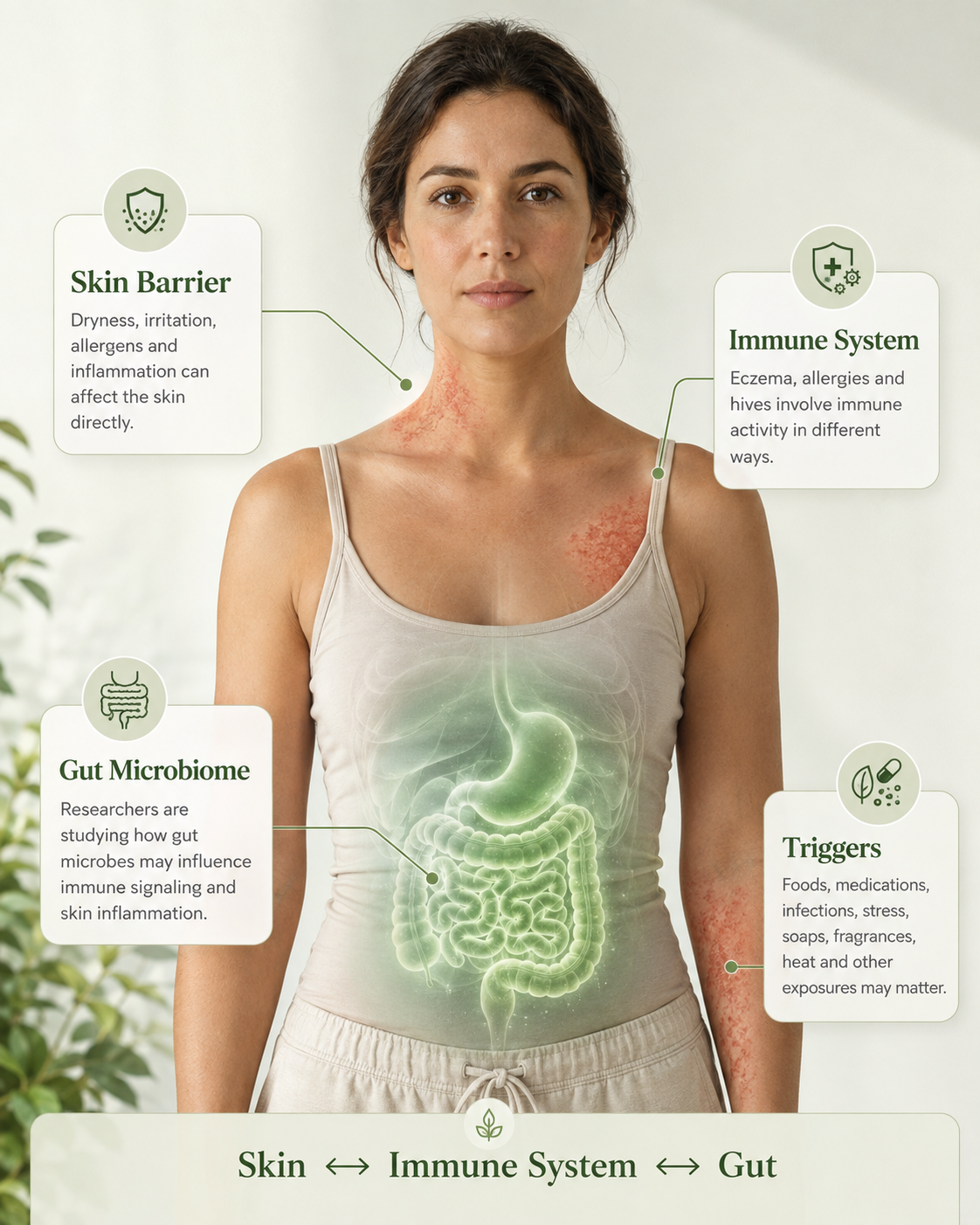
Your skin is not separate from the rest of your body. It has its own barrier, its own immune activity, and constant contact with the outside world — while your gut, microbiome, and immune system are also communicating in the background.
That does not mean every rash starts in the gut. But when skin problems keep returning — especially alongside food reactions, bloating, bowel changes, or other immune-related concerns — it can make sense to look at the bigger pattern.
Eczema, Hives and “A Rash” Are Different Things.
The words people use for skin symptoms often get mixed together. The pattern matters.
Dry, itchy, inflamed skin
Atopic dermatitis is a long-lasting inflammatory skin condition. It often causes dry, itchy patches and can flare again and again. Skin-barrier problems, genetics, immune activity, and triggers all play a role.
Raised, itchy welts that can move around
Hives often appear suddenly and may fade in one place while showing up somewhere else. Allergic reactions are one possible cause, but infections, medicines, temperature, pressure, and other triggers can also be involved.
One word can describe many different problems
Contact dermatitis, fungal infections, drug reactions, viral rashes, autoimmune skin disease, and many other conditions can look similar at first. A persistent or unusual rash may need direct medical examination.
Skin Problems Can Have Many Contributors.
Sometimes one factor stands out. Often several overlap.
Skin Barrier
When the skin barrier is dry or damaged, water escapes more easily and irritants or allergens can affect the skin more easily.
Soaps, Fragrances & Irritants
Skin-care products, detergents, metals, plants, chemicals, heat, sweat, and friction can trigger or worsen certain rashes.
Immune & Allergic Reactions
Eczema, hives, and food allergies involve the immune system in different ways. The exact mechanism matters.
Food Allergy — Sometimes
A specific food can trigger allergic skin symptoms in some people. But randomly removing many foods is not a reliable way to “cure” eczema.
Explore food sensitivities & intolerances →Microbiome Research
Both skin and gut have microbial communities. Research is exploring how these ecosystems may interact with immune regulation and inflammatory skin disease.
Explore the microbiome →Medications
Medicines and supplements can cause rashes or hives in some people. A new rash after starting something new deserves attention.
Stress & Sleep
Stress does not “cause every rash,” but it can worsen itching, scratching, sleep, and inflammatory symptoms in some people.
Explore the gut-brain connection →Infections & Other Conditions
Bacterial, viral, fungal, and parasitic infections can cause skin findings, as can autoimmune and other medical conditions. The right diagnosis matters.
Explore autoimmune-related gut concerns →The Connection Is Real. The Story Is Complicated.
Researchers increasingly describe a gut–skin axis — communication between the gut microbiome, immune system, metabolism, and the skin.
Studies have found differences in gut and skin microbial patterns in people with atopic dermatitis, and researchers are studying whether microbial byproducts may influence immune activity and skin inflammation.
Eczema does not prove that you have “leaky gut,” dysbiosis, a parasite, or a food sensitivity.
The science supports looking at connected systems. It does not support diagnosing the gut from a rash alone.
A simple way to picture the conversation
Do Not Turn Your Diet Into a Guessing Game.
Food can matter in specific people. That is very different from assuming every rash is caused by something you ate.
What People Often Try
- Cutting dairy, gluten, eggs, soy, nuts, and other foods all at once
- Buying broad “food sensitivity” panels and avoiding every positive result
- Adding random probiotics or supplements because the rash “must be gut related”
- Changing diets repeatedly without knowing whether the skin actually changes
- Assuming a food reaction is the same thing as a food allergy
A More Careful Approach
- Ask whether the same food reliably causes the same reaction
- Notice whether the reaction is immediate or delayed
- Keep nutrition adequate while investigating triggers
- Use allergy evaluation when the history supports it
- Avoid long-term food restriction without a clear reason
- Keep standard eczema skin care and medical treatment in the plan when needed
Track What Happens Around the Skin Flare.
Some Skin Reactions Should Not Wait.
Most rashes are not emergencies. But certain patterns need prompt or urgent evaluation.
Get emergency care for signs of a severe allergic or serious skin reaction:
- Trouble breathing or wheezing
- Swelling of the lips, tongue, mouth, or throat
- Fainting or severe dizziness
- Widespread blistering or peeling skin
- A rapidly spreading rash with fever or feeling very ill
- Hives together with breathing trouble or throat swelling
Those symptoms need medical care now — not a wellness consultation first.
We Look Beyond the Skin — Without Ignoring the Skin.
The goal is not to turn every eczema flare into a gut diagnosis.
The goal is to ask whether your skin symptoms are part of a larger pattern — and whether gut-health care, allergy or dermatology evaluation, medication review, or another next step makes the most sense.

Let’s Figure Out Whether Your Skin Symptoms Fit Into a Bigger Pattern.
The Health Clarity Session is designed to help sort through the history and decide what deserves attention next.
DocEllisDC is the education and wellness hub. Ellis Mobile Chiropractic is the active one-on-one care arm where Dr. Ellis works directly with patients.
Related Gut Health Topics
Skin symptoms can overlap with several other gut-health and immune-related concerns. These pages help connect the pieces.
Skin, Eczema & Gut Health FAQ
Can poor gut health cause eczema?
The relationship is not that simple. Atopic dermatitis is a complex inflammatory skin disease involving the skin barrier, immune system, genetics, environment, and other factors. Research supports a gut–skin connection, but a rash does not prove a gut diagnosis.
Is eczema the same thing as a food allergy?
No. People with eczema can also have food allergies, but eczema itself is not the same thing as a food allergy.
Should I eliminate dairy or gluten for eczema?
Not automatically. Dermatology and allergy guidance warns against unnecessary food restriction when a food allergy has not been demonstrated.
Can hives come from something I ate?
Yes, an immediate food allergy can cause hives. But hives also have many non-food causes. Hives with breathing trouble or swelling of the mouth or throat need emergency care.
What does “gut–skin axis” mean?
It is a term researchers use for communication between the gut, microbiome, immune system, metabolism, and skin.
Do probiotics treat eczema?
Research results are mixed, and dermatology guidance does not support treating eczema by simply adding a random probiotic.
Could parasites cause a rash?
Some parasitic infections can cause skin symptoms or immune reactions, but the appearance of a rash does not diagnose a parasite.
When should I see a dermatologist or allergist?
If a rash is persistent, severe, infected, repeatedly triggered by a specific exposure, difficult to control, or the diagnosis is unclear, direct evaluation can be very useful.
Your Skin Is Giving You Information. Let’s Figure Out What It Means.
If eczema, rashes, or hives keep returning — especially with digestive or food-related symptoms — you do not have to keep guessing at the connection.
Learn About the Health Clarity SessionMedical references used to guide this educational page
- American Academy of Dermatology. Atopic dermatitis overview.
- American Academy of Dermatology. Can food fix eczema?.
- American Academy of Dermatology / NIAID. Food allergy guidance.
- Qu B, et al. Microbial perspective on the skin–gut axis and atopic dermatitis. 2024.
- Salinas E, et al. Unraveling the gut-skin axis in atopic dermatitis. 2024.
Educational use only. This page does not diagnose eczema, food allergy, infection, autoimmune disease, intestinal permeability, or any other condition. Trouble breathing, swelling of the tongue or throat, fainting, widespread blistering or peeling, or a rapidly worsening rash with severe systemic symptoms requires prompt or emergency medical attention.